









Get ready for the EU's Cyber Resilience Act
Starting December 2027, Europe will no longer tolerate sloppy cybersecurity. If you can't guarantee your products will stay secure from first use to final shutdown, you won't be allowed to sell them.
The CRA: What you need to know
What is the Cyber Resilience Act?
Who needs to comply with CRA?
CRA key requirements
The software escrow — CRA connection
Let us help you be CRA compliant
Codekeeper's complete solutions for CRA requirements
Protection scope: Traditional software and firmware
Protection scope: Cloud-based components
Protection scope: Supporting infrastructure and services
Protection scope: All escrowed materials
Get CRA compliant in 4 simple steps
Book your CRA assessment call
We'll review your portfolio, then recommend the optimal escrow strategy for your specific CRA requirements.
Select your escrow solutions and verification level
Choose from Software Escrow, SaaS Escrow, and Continuity Escrow based on your product architecture.
We implement everything for you
Our team coordinates with your vendors, drafts all legal agreements, and facilitates automated deposit setups.
Get your compliance documentation
Order verification to receive Software Resilience Certificates proving your recovery capabilities — all ready for audits.
Codekeeper takes the complexity out of compliance
CRA D-day: It's time to plan for compliance
-
December 10, 2024
CRA enters into force across all EU member states -
September 11, 2026
Reporting obligations apply for cybersecurity incidents -
December 11, 2027
Main CRA obligations take effect for all manufacturers -
Ongoing from 2027
Continuous conformity assessments and CE marking requirements
December 10, 2024
September 11, 2026
December 11, 2027
Ongoing from 2027
The cost of missing CRA deadlines
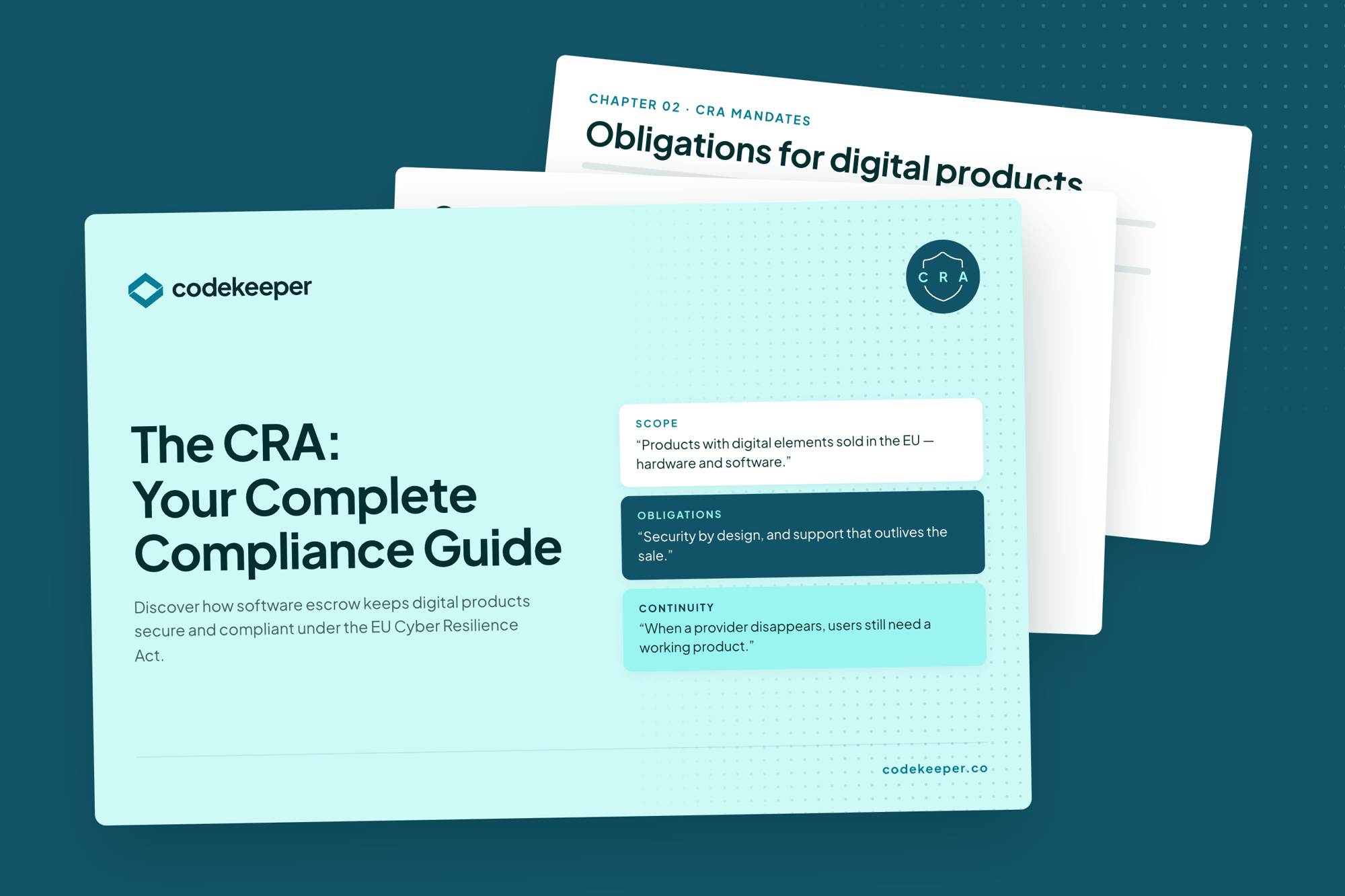
The CRA: Your Complete Compliance Guide
How you benefit from CRA compliance
Turn compliance into competitive advantage
Protect your business from disruption risks
Build investor and partner confidence
Secure your products ahead of the CRA deadline
Good questions to ask first.
What is the Cyber Resilience Act?
The CRA is Europe's cybersecurity law starting December 2027. It covers connected products and software sold in Europe. If you make these products, you must prove they won't abandon customers during their lifetime to get CE marking and market access.
Why is software escrow important for CRA compliance?
Software escrow aligns with CRA requirements for vulnerability handling and product support. It ensures customers have access to critical source code to maintain products and fix problems when your business can no longer provide support — exactly what Europe requires for CE marking.
Can Codekeeper help with CRA compliance?
Yes. We help device manufacturers and software developers meet CRA requirements by ensuring products stay available and resilient. Our platform stores your software and verifies it works for recovery, handles the legal paperwork, and provides certificates proving your compliance readiness.
What happens if I don't comply with the CRA?
You face fines up to €15 million or 2.5% of global revenue. Additionally, products without CE marking can't be sold in Europe, and regulators can force recalls or market bans.
How does the CRA affect different types of organizations?
The CRA impacts organizations differently based on their role in the supply chain. Device manufacturers face the most extensive requirements since they're responsible for proving operational resilience. Software companies also need to comply, but only when they develop commercial connected products. Meanwhile, importers, distributors, and resellers have their own specific obligations, though they risk being classified as "manufacturers" and facing even stricter requirements.
When do I need to start preparing for CRA compliance?
You should start preparing immediately, even though the main rules don't apply until December 2027. The CE marking process requires significant lead time, and some reporting requirements may begin earlier than the main deadline. Since Europe is still developing the detailed implementation standards, you'll need ample time to understand the requirements, implement necessary changes, and compile all the required documentation.